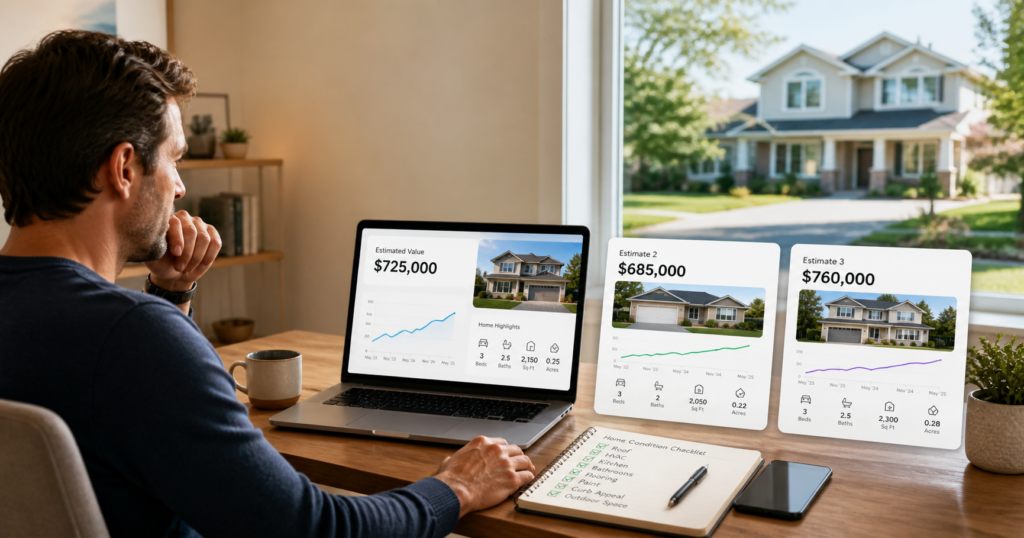
Online home value estimates are now one of the first places homeowners, buyers, sellers, agents, and lenders look when trying to understand a property’s value.
Tools from major real estate websites can be useful starting points. They give consumers quick access to an estimated value without needing to call anyone, schedule an appointment, or share personal information.
But there is one important problem:
An online estimate may not know enough about the actual condition, updates, repairs, or improvements of the home.
That is where many online home value estimates can become misleading.
Why Online Home Estimates Can Miss the Mark
Most online estimates are based heavily on public records, recent sales, tax data, location, square footage, bedroom and bathroom counts, and broad market trends.
Those are important pieces of information, but they do not always tell the full story.
For example, two homes may look very similar in public records:
- Same neighborhood
- Similar square footage
- Same age
- Similar lot size
- Similar bedroom and bathroom count
But one home may have:
- A new kitchen
- Updated bathrooms
- A finished basement
- A newer roof
- Updated mechanical systems
- Better landscaping
- Superior overall condition
The other home may have older finishes, deferred maintenance, worn roofing, an unfinished basement, or outdated systems.
To a homeowner or buyer, those differences can be obvious.
To an automated estimate, they may be partly missed or not fully reflected.
The Problem With “One Number”
Many people look at a single online estimate and treat it as the value of the home.
That can be risky.
A home value estimate is not the same thing as a full appraisal, a professional market analysis, or an offer from a buyer. It is an automated opinion based on available data.
The issue is not that online estimates are useless. The issue is that they can be incomplete.
A better approach is to start with one or more popular online estimates, then ask:
Does this estimate reflect what is actually inside and around the home?
Condition and Updates Matter
In real estate, condition can significantly affect value.
A remodeled kitchen, updated bathrooms, newer roof, finished basement, or recently replaced furnace and air conditioning system may influence how buyers react to a property.
On the other hand, needed repairs or dated features can reduce buyer interest or support a lower value expectation.
This is especially important in older neighborhoods, low-turnover markets, and areas where homes vary widely in effective age and renovation quality.
In those cases, public records may show the age of the home, but not the true condition of the home.
A Better Way to Check an Online Estimate
Instead of relying on one number, homeowners can take a more practical approach.
Start with an estimate from a major real estate website. Then review the property condition and major features that may not be fully captured.
That is the purpose of:
AVMOptimizer.com
HomeValueOptimizer.com
These tools help users take an existing online value estimate and adjust it based on important property features such as kitchen condition, bathroom condition, basement finish, roof condition, mechanical systems, and landscaping.
HomeValueOptimizer.com also allows users to compare and reconcile up to three online estimates, giving a broader view of what consumers may already be seeing across the real estate portals.
Why This Matters Before You Talk to an Agent or Lender
Many homeowners want to understand value before they contact a real estate professional.
They may be thinking about selling, refinancing, removing PMI, applying for a home equity loan, appealing taxes, or simply checking whether an online number seems reasonable.
Using an optimizer before those conversations can help the homeowner become better prepared.
It does not replace an appraisal, lender review, or real estate professional’s opinion.
But it can help answer a very important question:
Is the online estimate likely missing something important?
The Bottom Line
Online home value estimates are useful starting points, but they are not always complete.
They may not fully account for renovations, condition, repairs, upgrades, or differences that matter in the real market.
Before accepting an online estimate as accurate, homeowners should take a few minutes to check whether the estimate reflects the actual property.
That is exactly what AVM Optimizer and Home Value Optimizer are designed to help with.
Start with the online estimate. Then optimize it.
Visit:
AVMOptimizer.com
HomeValueOptimizer.com