Portal Value: A New Term Every Listing Agent Should Understand
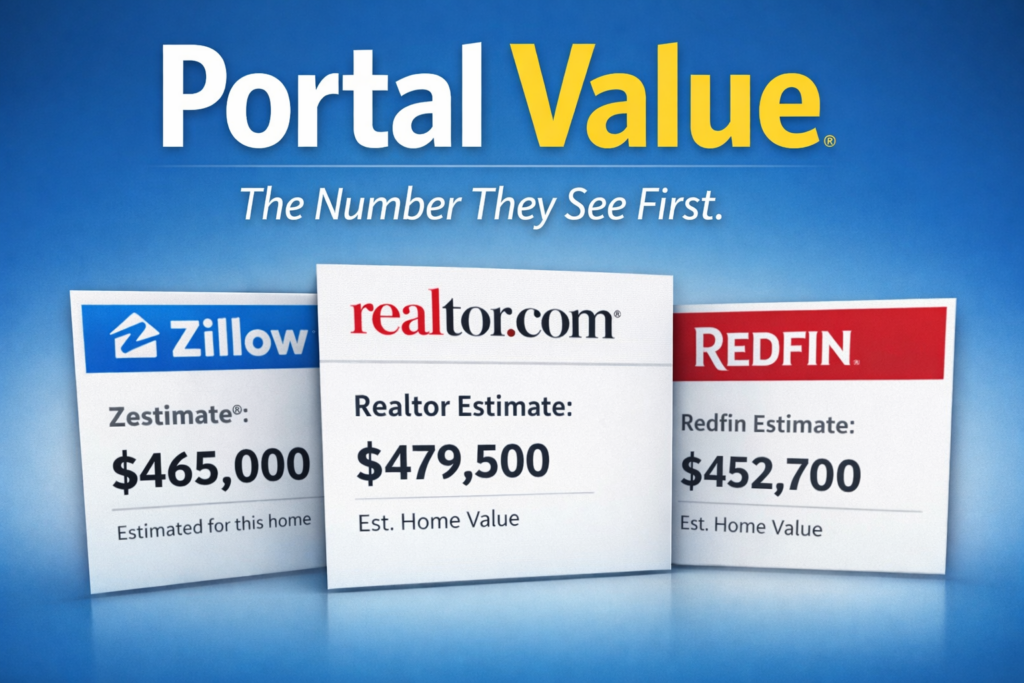
In today’s housing market, consumers often see a home’s value online before they ever speak with a real estate professional. They check Zillow, Realtor.com, Redfin, Homes.com, Trulia, and other real estate websites to get an instant idea of what a property may be worth. Those numbers may not be perfect, but they are already influencing expectations, conversations, and decisions.
That reality deserves a name.
Portal Value is the home value impression created by the real estate portals consumers use before they speak with a listing agent, lender, or appraiser.
It is not necessarily the same as true market value. It is not an appraisal. It is not always the number a home will sell for. But it is often the first value that buyers and sellers see, and because of that, it matters.
Why Portal Value matters
For many homeowners, Portal Value is the starting point for how they think about their property. Before the listing appointment, before the CMA, and before the first professional conversation, many sellers have already formed an opinion based on one or more online estimates.
That means listing agents are no longer dealing only with market value. They are also dealing with Portal Value.
If a seller sees a higher number online, that number can shape expectations and influence pricing discussions. If buyers see a lower number online, that can affect how they react to a new listing. Even when the online number is incomplete or wrong, it can still influence perception.
Ignoring Portal Value does not make it go away.
The leading AVMs are already out in the market, and they must be understood and dealt with. Any listing agent who wants to advise sellers well should understand not only what the market is saying, but also what the portals are suggesting.
What Portal Value really means
Portal Value is best understood as a digital first impression of value.
It is the number or range created by consumer-facing AVMs and real estate portals based on the data they have available. Those models may be useful, but they often cannot fully account for condition, updates, deferred maintenance, quality of remodeling, finished basement appeal, landscaping, and other details that can significantly affect value.
That is why Portal Value should not be treated as final value. It should be treated as an influential starting point.
For professionals, that distinction is important. A seller may walk into a conversation thinking the online number is “the value.” A good agent understands that the portal number is only part of the picture. At the same time, a good agent also understands that Portal Value has become part of the marketplace and should be addressed directly, not dismissed.
How listing agents can use Portal Value
Portal Value can be useful when handled the right way.
A listing agent can use it to better understand the seller’s mindset before discussing price. If the seller has already seen two or three online estimates, those estimates have likely shaped expectations. Knowing that helps the agent prepare a better pricing conversation.
Portal Value can also help agents explain the gap between an online estimate and actual market evidence. When an online estimate seems too high or too low, that opens the door to a stronger discussion about condition, updates, competing listings, recent sales, and the differences between public data and real-world property details.
It can also help with positioning. If a home’s Portal Value is lower than what market evidence supports, that may mean the property’s true strengths are not being fully recognized online. If the Portal Value is higher than what current market conditions support, the agent can explain why pricing only to the portal number may be risky.
In other words, Portal Value is not something to fear. It is something to understand and use.
A smart way for consumers to use Portal Value
For consumers, one of the best starting points is not to rely on just one online estimate.
A better approach is to gather three popular portal estimates and compare them. That creates a more balanced picture and reduces the risk of putting too much weight on one AVM. Once those numbers are collected, the next step is to refine and reconcile them using real property details such as condition, updates, and features.
That is where Home Value Optimizer and AVM Optimizer become especially useful.
How the Optimizer helps explain Portal Value
The problem with many portal estimates is not that they are useless. The problem is that they may be incomplete.
A portal may know the square footage, lot size, bedroom count, bath count, and recent sales activity. But it may not know that the kitchen was fully remodeled, that the basement was professionally finished, that the roof is brand new, or that the mechanical systems are outdated. It may not know whether the home shows like average, below average, or much better than the surrounding competition.
That is exactly why Portal Value needs context.
Home Value Optimizer helps by allowing the user to enter up to three online AVM values and then refine those values using additional property-specific questions. This creates a better-informed result and helps the user reconcile the differences among major portals rather than blindly trusting one number.
AVM Optimizer works from the same basic idea. It gives consumers and professionals a practical way to improve an online estimate by considering factors the original AVM may have missed or only partly understood.
This matters because in today’s market, the first value many people see is digital, but that does not mean it is complete.
The Optimizer helps turn Portal Value from a vague online impression into a more reasoned and explainable starting point.
Why this matters for lenders too
Portal Value is not just important for listing agents. It also matters for lenders because borrowers are often influenced by online values before making decisions about refinancing, home equity loans, cash-out options, PMI removal, or purchase timing.
A borrower who sees a strong online value may assume they have more equity than they really do. Another may underestimate their position because the portal does not reflect improvements made to the home. In either case, the portal number influences behavior.
Understanding Portal Value gives lenders a better way to discuss expectations and guide borrowers toward a more informed view.
The bottom line
Portal Value is a term worth understanding because it reflects how today’s housing market actually works.
Consumers are seeing online values first. Those values influence expectations. They shape pricing conversations. They affect buyer and seller perception. They are already in the market, and they must be understood and dealt with.
That does not mean professionals should surrender to them. It means professionals should be prepared to explain them, challenge them when necessary, and improve on them when better information is available.
That is why Portal Value matters.
And that is why tools like Home Value Optimizer and AVM Optimizer are important. They help consumers, listing agents, and lenders move beyond the raw portal number and toward a more useful understanding of value.
In a market where digital impressions matter, Portal Value may be the first value people see. The real opportunity is to understand it, refine it, and use it wisely.